

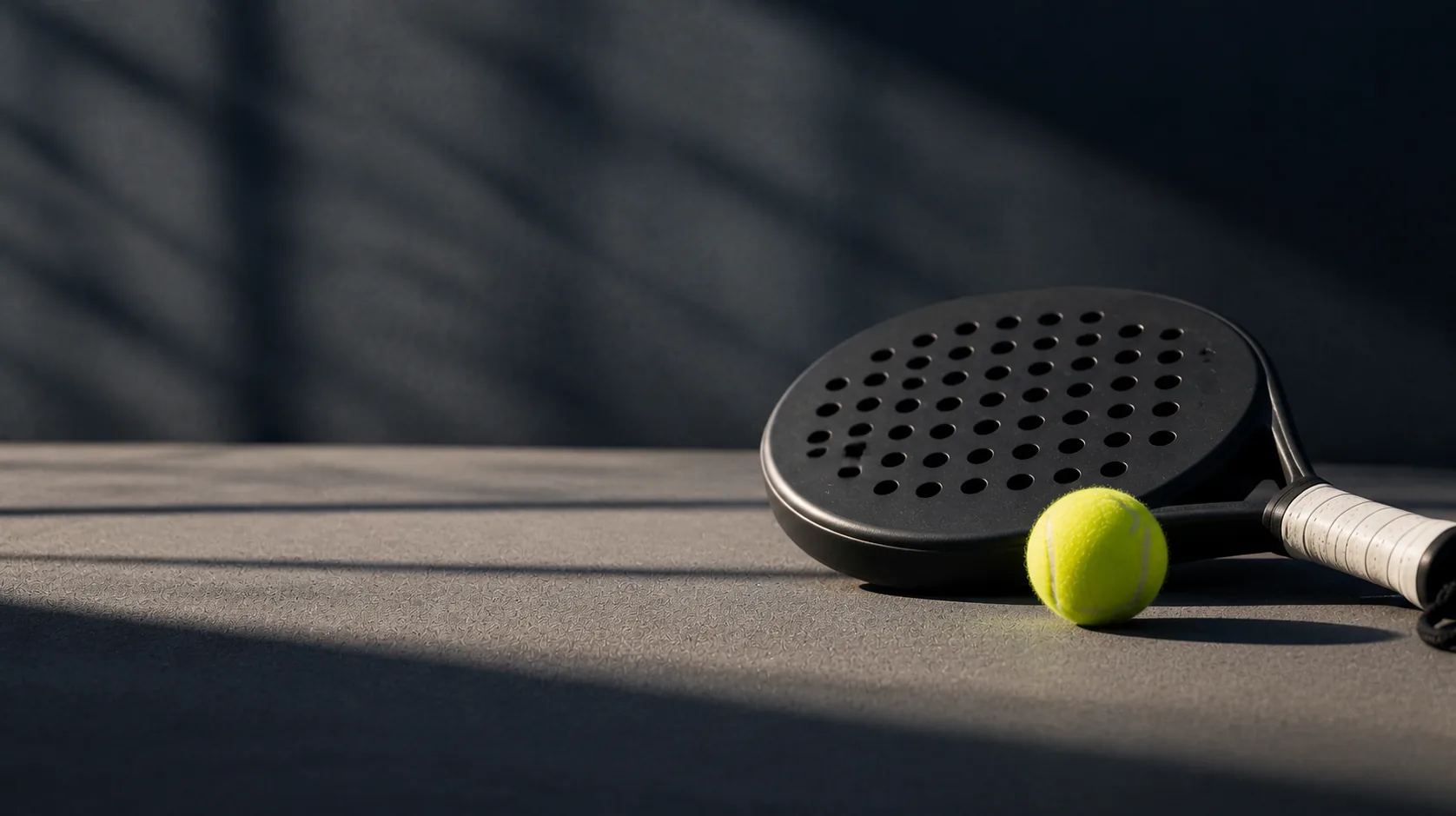
Padel is doubles only. You serve underarm, diagonally, with one bounce. The ball must hit the floor before it can be played off a wall. Tennis-style scoring (15, 30, 40, deuce, advantage) is used. Sets are first-to-six games, matches usually best of three. Glass walls are part of the court — you can play the ball off them.
The court
A padel court is 20 metres long and 10 metres wide, divided in half by a net 88 cm high in the middle (rising to 92 cm at the posts). The court is enclosed: the back walls and the lower section of the side walls are tempered glass, while the top section of the side walls is metal mesh. The court is the same on both sides — there are no "deuce/ad" corners marked except by the central service line.
The service box on each side is marked 6.95 m from the net and ends 2 m before the back wall, divided into a left and right box by the central service line.
Serving
The serve is the most distinctive feature of padel for new players.
- Always underarm. Bounce the ball on the ground behind the service line, then strike it at or below waist height.
- Diagonal. The serve must land in the diagonally opposite service box, the same as tennis.
- Two attempts. You get two serves per point.
- Behind the line and out wide of the box.One foot must be behind the service line at the moment of contact, and you can't step over the central service line until the ball has been struck.
Serve faults
A serve is a fault if any of these happen:
- It misses the correct service box.
- It lands in the correct box but then hits the side fencing/mesh before the receiver plays it.
- It hits the net and doesn't land in the correct box.
- The server bounces the ball wrong (must be one bounce on the floor before contact).
- The server contacts the ball above waist height.
- The server steps on or over the service line during contact.
Two consecutive faults = the point goes to the receiving team (a "double fault").
Let serves
If your serve clips the net but still lands in the right box, it's a let and you replay it. Unlike many sports, there is no limit on how many lets you can have in a row — they keep being replayed.
During the rally
Once the ball is in play, the rules are mostly intuitive — but the walls are where padel diverges from tennis.
Floor first, then walls
The single most important rule: the ball must hit the floor before any wall on the receiving side. If the ball hits any wall first, the point is over — for example, if your opponent hits a booming forehand and it slams into your back glass without bouncing, you've won the point.
After the ball has bounced once on the floor, it can rebound off the back wall, the side walls, or both, and you can still play it. It can only bounce on the floor once before you must hit it.
Playing off your own walls
It's legal — though rarely the best play — to let the ball rebound off your own glass back wall after one bounce on the floor and return it back over the net. The ball must travel back over the net, not into your own walls again.
Out of court
Hitting the ball over the back glass or out of the side fencing entirely is notautomatically a fault. If the ball has bounced on your opponents' side first, sending it out of the court on the rebound is a winner — this is the legendary "por tres" smash. If you put it out before it has bounced on the opposite side, it's out and the point is theirs.
Scoring
Padel uses tennis scoring:
- Points within a game: 0 (love), 15, 30, 40, game.
- At 40-40 (deuce), you need to win two consecutive points: advantage then game. Many leagues use a "golden point" rule where the next point at deuce wins the game outright — quicker for time-capped formats.
- First team to six games wins a set, with a two-game lead.
- At 6-6 a tie-break is played: first to 7 points, win by 2.
- Matches are usually best of three sets.
For a complete walkthrough of scoring including deuce, advantage and tie-break sequences, see our padel scoring guide.
Time-capped formats
Most amateur leagues — including Padel Loop — play within a fixed court booking (typically 90 minutes). If the booking expires mid-match, you stop where you are: the team ahead wins; if scores are level, the match is a draw.
Conduct & etiquette
- Call your own lines. Most amateur padel is self-officiated; honest, generous calling is the norm.
- Mind the courts next to you. If a ball rolls onto your court from a neighbouring one, stop the point and replay it.
- Don't hit teammates. Hitting your partner with your racket or the ball is just bad luck — the point still counts as a fault if it occurred during the swing.
- Be on time. Most clubs have back-to-back bookings, and starting late means finishing late.
Common faults beginners hit
- Trying to serve overarm. Watch a tennis player on their first padel session — old habit.
- Volleying back wall returns.If the ball would have come off your back wall harmlessly, let it bounce — it's usually easier to play.
- Smashing flat into the back glass. The ball bounces straight back to your opponent. Smash with topspin or angle so it either kicks up out of the cage or dies at the back.
- Standing back too much. The team that controls the net wins most amateur points.
Frequently asked questions
Do you serve overarm or underarm in padel?
You serve underarm in padel. The ball must be bounced once on the floor, then struck at or below waist height into the diagonal service box on the receiver's side.
Can the ball bounce off the wall before the floor in padel?
No. The ball must always touch the floor first. If a ball hits a wall before bouncing on the floor on the receiving side, it's a fault and the point is over.
Can you play the ball off your own walls in padel?
Yes. After the ball has bounced on your side, you can play it after it has rebounded off your own glass back wall or side walls and return it back over the net. It's legal but rarely the best tactical choice.
What is a let in padel?
A let in padel is when the served ball clips the top of the net but still lands in the correct service box. The serve is replayed. Two consecutive lets do not count as a fault.
How long is a padel match?
A typical padel match is best of three sets and lasts 60 to 90 minutes. In leagues with time-capped bookings (like Padel Loop), if the booking ends mid-match the team ahead wins; if scores are level it's a draw.
Can you smash the ball out of the court in padel?
Yes. Hitting the ball over the back glass or side fencing so it leaves the court entirely (a 'por tres' or 'out-of-cage' shot) is a legal winner, provided the ball bounced on your opponents' side first. It's one of padel's signature shots.
Want a deeper read on scoring? See padel scoring explained. Or jump straight to joining the Padel Loop waitlist to play a weekly fixture in London, Birmingham or Nottingham.