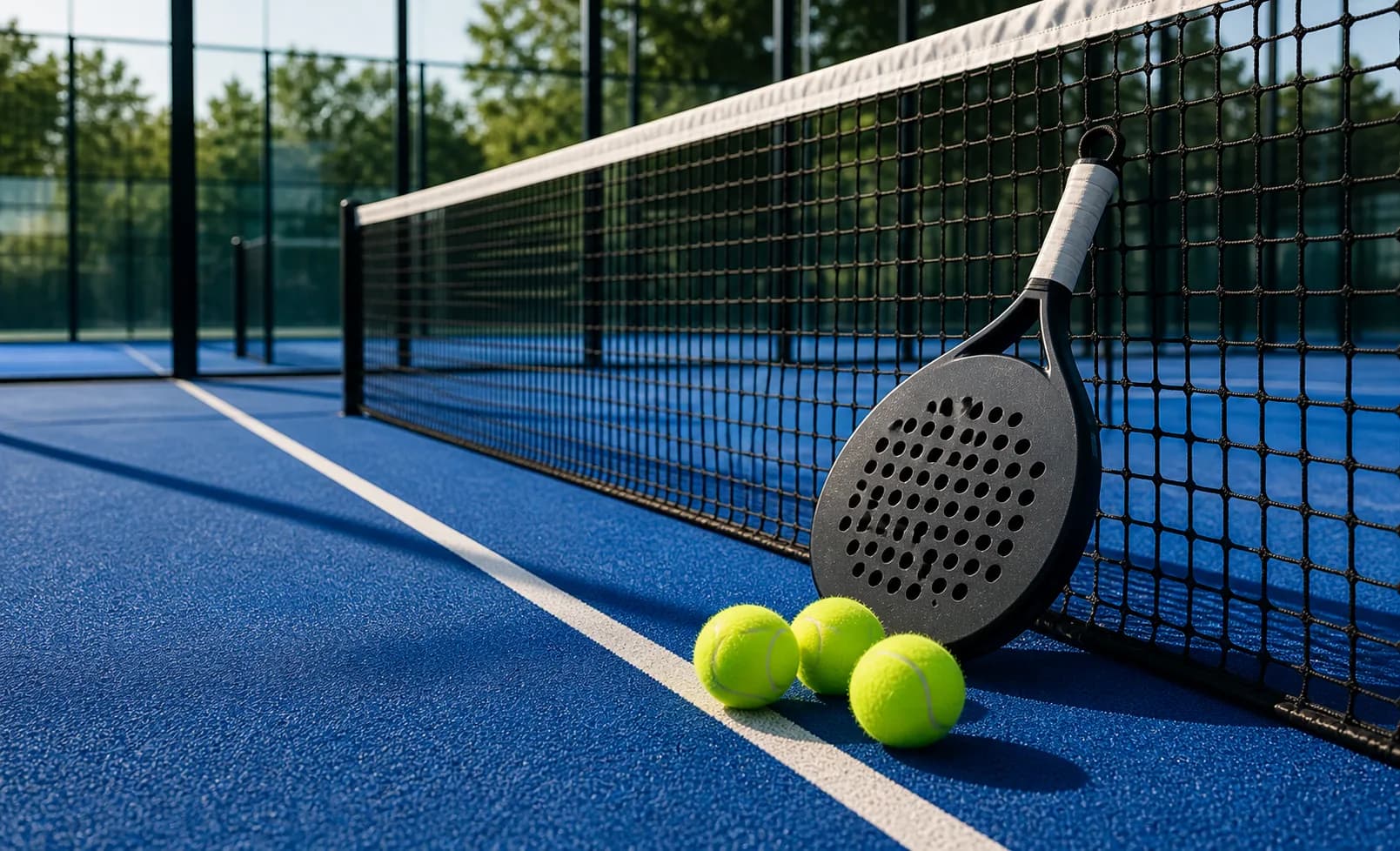

Padelis a doubles racket sport played on an enclosed court about a third the size of a tennis court. It uses solid rackets, a slightly depressurised tennis ball, and glass walls you can play the ball off — combining elements of tennis and squash. Tennis-style scoring is used. It's easier to learn than tennis, very social (always doubles), and is currently one of the fastest-growing sports in the UK and the world.
What is padel?
Padel is a racket sport played in pairs on an enclosed court roughly 20 metres long by 10 metres wide — about a third the size of a tennis court. The court is surrounded by glass walls and metal mesh, and points can be played off those walls in a similar way to squash. You serve underarm, score in tennis points (15, 30, 40, deuce, advantage, game), and play first-to-six-games sets, usually best-of-three.
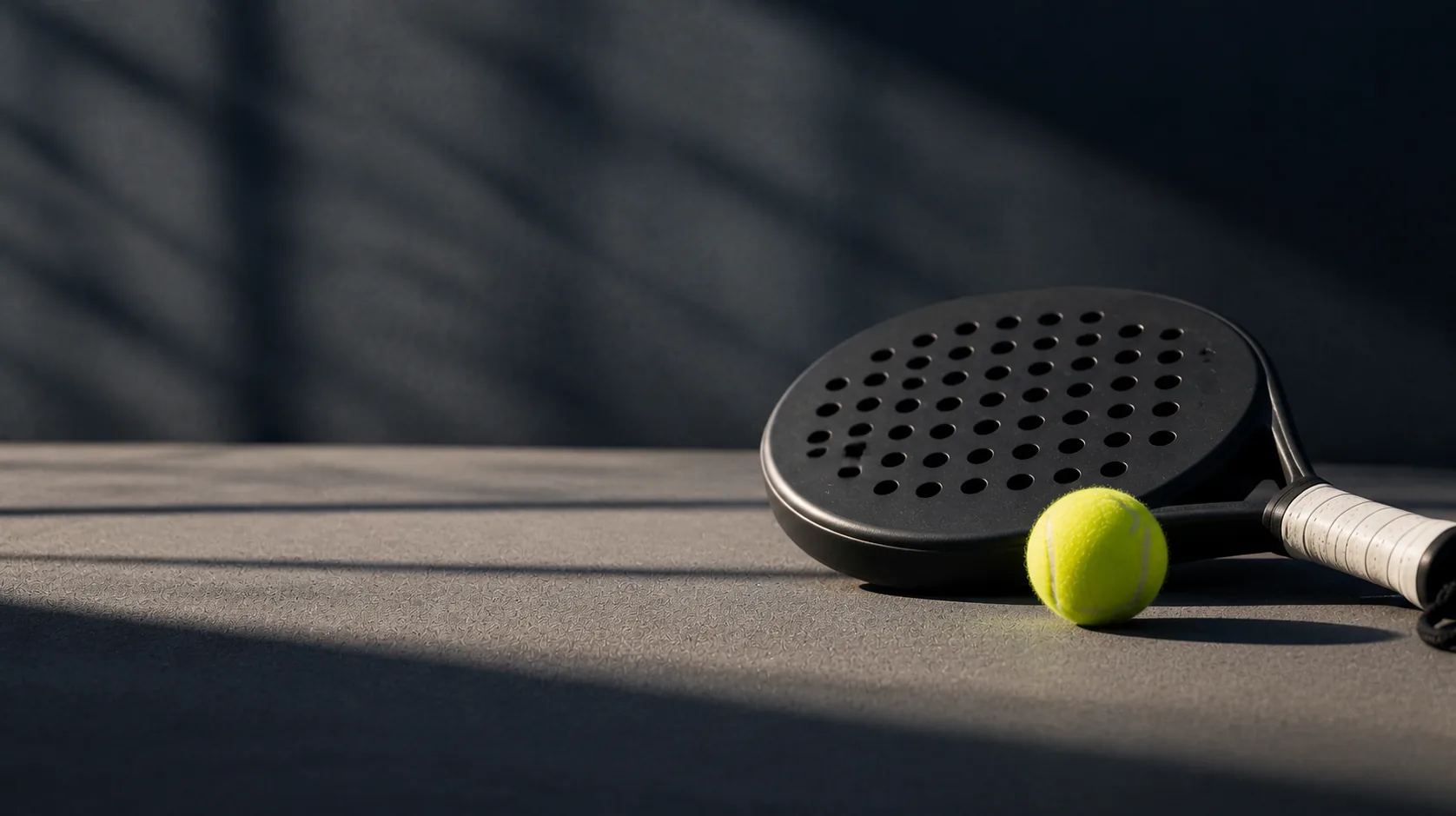
Padel uses a solid, stringless racket— usually a foam core wrapped in carbon or fibreglass, with a perforated face. The ball is essentially a tennis ball with slightly less internal pressure. The smaller court, walls and underarm serve mean rallies tend to be longer and tactical rather than power-driven, which is part of why it's such a sociable, accessible sport.
How padel is played
Padel is always doubles. Each team of two stands on one side of a net (90 cm in the middle, slightly higher at the posts). The server serves underarm, with the ball bouncing once before it's struck — diagonally into the opponent's service box, like in tennis. The ball must bounce on the floor before hitting any wall on the receiving side; the receiver can then play it directly off the floor or after it bounces off a wall.
The crucial thing that makes padel different is the walls. If a ball passes you, you can chase it back, let it bounce off the back glass and play it back over the net — turning what would be a winner in tennis into a long, tactical exchange. Conversely, hitting a clean winner usually means going through your opponents, not over them: angled cross-court volleys, smashes that bounce out of the cage, and short, low shots near the net.
The basic rules
- Always doubles — two players per side, on a court ~20m × 10m.
- Serve underarm, diagonally, into the receiver's service box.
- The ball must bounce on the floor before being struck on the receiving side.
- The ball is in play if it bounces on the floor first, then off a wall — but never if it touches a wall before the floor.
- Tennis-style scoring: 15, 30, 40, deuce, advantage, game. First to six games wins a set; usually best-of-three.
- You can play the ball off your own walls back over the net (rare, but legal).
For a complete walkthrough of the rules, see our padel rules explained guide.
How padel differs from tennis
On the surface, padel and tennis look similar — net, racket, ball, scoring. They play very differently, though. The court is smaller, the rackets are shorter and stringless, the ball is slightly less bouncy, and the walls fundamentally change how rallies play out. We've written a much longer breakdown of this in our padel vs tennis guide, but the short version:
- Easier to learn. Beginners are rallying within their first session. Tennis takes far longer to feel competent in.
- More social. Always doubles, shorter format, smaller court — chatting between points is built in.
- Different shots.The walls reward placement, touch and angle over raw power. Smashes "por tres" (out of the back of the cage) are spectacular.
- Less running. The smaller court means less ground to cover, which is part of why padel works for a wider age range.
Why padel is so popular right now
Padel has been the world's fastest-growing racket sport for several years. There are a few reasons it's exploded:
- Low barrier to entry. Beginners can have fun in their first hour. Tennis, squash and badminton all have a steeper early curve.
- Always doubles.The sport is built around playing with friends, partners and family. It's less "turn up alone" than most racket sports.
- Quick and visual. Matches are typically 60–90 minutes. The walls make for highlight-friendly, share-able rallies.
- Compact venues. A padel court is a third the footprint of a tennis court, so clubs can install several in the same space and gym chains have been adding them.
Padel in the UK
Padel arrived late in the UK compared to Spain or Italy, but court numbers have grown rapidly in recent years. Most major UK cities now have at least one dedicated padel venue, and the LTA — the national governing body for tennis and padel — actively encourages clubs to add padel courts. London, Birmingham, Manchester, Leeds, Bristol and Nottingham have all seen meaningful growth.
That said, "regular play" in the UK is still surprisingly hard to organise. Most amateur padel happens via WhatsApp groups, ad-hoc bookings or pickup sessions — which means dropouts, mismatched levels and no real structure. That's the gap Padel Loop exists to fill: a structured, level-based amateur padel league with 8 teams, 7 fixtures and promotion/relegation across London, Birmingham and Nottingham.
How to get started with padel
If you've never played before, the first three steps are straightforward:
- Book your first session.Most padel clubs let you hire a court for 90 minutes. Bring three friends or look for a beginner social. The Playtomic app is the easiest booking tool in the UK; the LTA's "Find a Court" tool also lists most venues.
- Borrow or hire a racket for the first few sessions. Most clubs hire rackets out so you don't need to commit before you know you like it. When you're ready to buy, see our beginner padel racket guide.
- Play regularly. One session a week beats four sessions in a fortnight. The fastest way to improve — and to enjoy it — is to commit to a fixed slot. A league makes that automatic; you can join the Padel Loop waitlist if you want one of those.
Frequently asked questions
What is padel?
Padel is a doubles racket sport played on an enclosed court that's about a third the size of a tennis court. It uses solid (no-string) rackets, a slightly depressurised tennis ball and glass walls that the ball can be played off, like in squash. Tennis-style scoring is used.
Is padel the same as paddle tennis or pickleball?
No. Padel is its own sport. Paddle tennis is an older American game played on a smaller, wall-less court. Pickleball is played with a perforated plastic ball on a court with no walls. Padel is played in an enclosed glass-walled court with tennis-style scoring and is bigger globally than either.
Where did padel come from?
Padel was invented in Acapulco, Mexico, in 1969 by Enrique Corcuera. It became popular in Spain and Argentina in the 1970s and 1980s and is now one of the world's fastest-growing sports, with millions of players in Spain, Italy, Sweden, Argentina and increasingly the UK.
Why is padel so popular?
Padel is easier to pick up than tennis, very social (always doubles), short-format (a typical match runs 60–90 minutes), and works well for mixed-ability groups. It's why it's grown faster than almost any other sport globally over the past decade.
Is padel hard to learn?
Padel has one of the gentlest learning curves of any racket sport. Beginners can rally and play points within their first session. The walls actually help — they give you a second chance to reach the ball — and the smaller court means less running. Mastering the strategy and shots takes much longer.
Next: ready to play? Read our padel rules guide or join the Padel Loop waitlist to play in a weekly amateur league across London, Birmingham or Nottingham.